Most B2B companies I speak to have the same complaint: organic traffic is going up, and sales still says the website never sends them anyone worth talking to. That gap is almost always a strategy problem, not an effort problem. In this guide I will walk you through the B2B SEO strategy I actually use, in the order I build it, so your search work ends up in the pipeline report and not just the traffic chart.
Why most B2B SEO strategies stall
The typical approach copies consumer SEO. Find high-volume keywords, publish lots of blog posts, build some links, report on sessions. It looks busy, and the graphs go up and to the right.
The trouble is that B2B buying does not work like consumer buying. Gartner's research describes a buying group of six to 10 decision makers for a complex purchase, and those buyers spend only around 17% of their buying time meeting potential suppliers. Salesforce's State of Sales found 81% of sales reps say buyers increasingly research before they ever reach out. In other words, most of the decision happens on screens you do not control, and search is one of the biggest of those screens.
So a good B2B SEO strategy is not about attracting the most people. It is about being present, credible and easy to choose at the moments when the right people at the right companies are searching.
Step 1: Write for the buying committee, not one persona
One B2B deal can involve a founder, a finance head, an IT or security lead, an operations manager and a procurement team. Each of them searches differently, and each of them can quietly veto you.
Before touching a keyword tool, I sit with sales and write down who is on a typical deal and what each person needs to believe. A simple version looks like this:
| Role | What they search for | What your page must answer |
|---|---|---|
| Economic buyer (CFO, founder) | Pricing, ROI, total cost | Is this worth the money, and what does it cost over a year? |
| Technical evaluator (CTO, IT) | Integrations, security, compliance | Will it work with our stack and pass our audit? |
| Day-to-day user (ops, marketing) | Features, how-to, workflow fit | Will this make my week easier or harder? |
| Procurement | Vendor comparisons, contracts | Is this vendor safe, and how do they compare? |
This table becomes the backbone of your B2B content strategy. Every important page should serve at least one of these people clearly, and your most important pages should serve several.
Step 2: Build bottom-of-funnel pages first
This is the step most teams skip, and it is the one I insist on in every B2B SEO strategy I build. Before writing a single "what is" blog post, make sure you rank for the searches people make when they are already close to buying.
Semrush groups search intent into informational, navigational, commercial and transactional. For B2B, the commercial and transactional end is where the money is: searches with words like "pricing", "vs", "alternatives", "best", "software for" or "services in Mumbai". These terms often show tiny volumes in keyword tools. HubSpot's own B2B SEO guidance makes the same point: decision-stage terms deserve priority even when volume is low.
Say you sell a compliance automation platform to mid-sized Indian NBFCs. A search for "RBI compliance software for NBFC" might show 30 searches a month. If two of those people book a demo each quarter and your average contract is ₹15 lakh a year, that one page is worth more than a blog post with 5,000 monthly visitors who never convert.
If you want a practical method for finding these terms, my guide to B2B keyword research covers sales call mining, CRM notes and Search Console in detail.
Step 3: Make product and solution pages do real work
In most B2B sites I audit, the product pages are written for the board deck, not for a searcher. They are vague, short and full of words like "seamless" and "end-to-end".
A product or solution page that ranks and converts usually has:
- A clear statement of who it is for, by industry, company size or role.
- The problem in the buyer's own words, ideally phrases you have heard on sales calls.
- How it works, with enough detail that a technical evaluator does not need a call to understand it.
- Proof: case studies, client logos, certifications, numbers you can stand behind.
- Pricing or at least pricing logic. Even "plans start from INR 40,000 a month" filters out the wrong people and reassures the right ones.
- One clear next step, such as booking a demo or talking to a specialist.
Build separate pages for each major use case and industry you serve. "Inventory software" is one page. "Inventory software for pharma distributors" is another, because the buyer, the vocabulary and the objections are different.
Step 4: Own your comparison and alternative pages
Your buyers are going to compare you with competitors whether you like it or not. The only question is whose page they read while doing it.
I recommend three types of pages:
- "You vs competitor" pages for your two to five most common competitors in deals.
- "Competitor alternatives" pages for buyers unhappy with an incumbent tool or agency.
- "Best X for Y" roundups in your category, where you include yourself honestly alongside others.
The rule that makes these work is honesty. Say clearly where a competitor is a better fit. Buyers can smell a rigged comparison, and an honest page earns trust that carries into the sales call. Ask your sales team which competitors come up most often and what prospects say about them. That conversation will write half the page for you.
Step 5: Get the technical basics right
B2B sites are often built by agencies, rebuilt every few years, and stitched together with landing page tools and gated PDFs. That creates technical mess that quietly blocks rankings.
Google's SEO Starter Guide covers the fundamentals well. The ones I check first on B2B sites:
- Crawling and indexing. Use the URL Inspection tool in Search Console to confirm your key product and solution pages are actually indexed.
- Duplicate pages. Landing page variants and old campaign URLs create duplicates. Use canonical tags or redirects so Google knows which version matters.
- Descriptive URLs and titles. Every important page needs a unique, clear title that describes what the page is about.
- Gated content. If your best thinking lives inside a PDF behind a form, Google cannot see it. Publish a useful HTML version and gate a deeper asset instead.
- No keyword stuffing. Google is direct about this: "keyword stuffing is against Google's spam policies." Write for the reader.
Google's guidance on people-first content also matters here. It asks you to make it clear who wrote a page and why. For B2B, named authors with real experience, real case studies and specific detail all help both readers and search engines trust you.
Step 6: Add early-stage content once the base is solid
Once your bottom-of-funnel and product pages are in shape, then build the educational layer: guides, explainers, glossaries and frameworks for problems your buyers face before they know a solution exists.
The difference is that this content now has somewhere useful to send people. Every guide should link to the relevant solution or comparison page. Think of it as a cluster: one strong pillar page on a topic, with supporting articles linking into it and out to the pages that convert. A B2B marketing glossary is a good example of low-effort, high-usefulness content that helps every member of the buying committee get on the same page.
This layer also feeds AI search. Tools like ChatGPT, Perplexity and Google's AI Overviews pull from clear, specific, well-structured pages. If that is a priority for you, my explainer on generative engine optimisation covers how to get named in those answers.
Step 7: Measure pipeline, not traffic
This is where B2B SEO earns or loses its budget. If your monthly report shows sessions and rankings only, finance will eventually ask what any of it is worth, and nobody will have a good answer.
Salesforce describes a shift towards marketing that is judged on sales opportunities, not just leads, because deals involve several decision makers. I apply the same thinking to SEO. The metrics I report, in order of importance:
| Metric | Why it matters |
|---|---|
| Organic pipeline value | The rupee or dollar value of opportunities that started from organic search |
| Organic opportunities | How many qualified sales conversations SEO created |
| Lead to opportunity rate | Whether the right companies are coming in |
| Organic leads by page | Which pages actually produce enquiries |
| Rankings and impressions for money terms | Early signal that you are moving in the right direction |
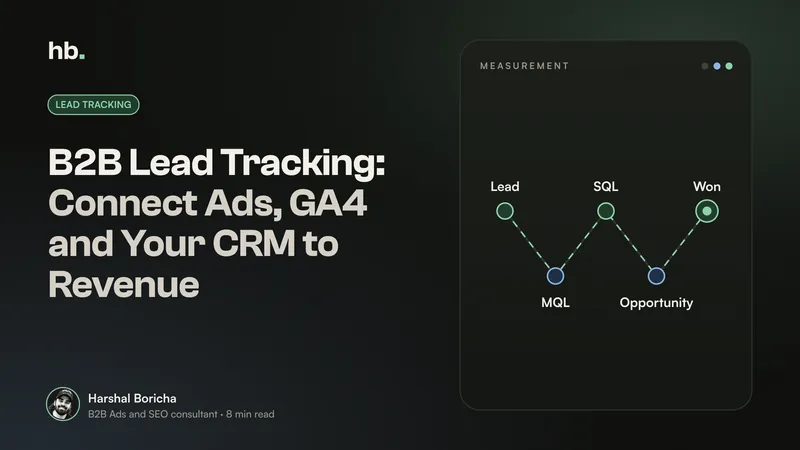
To do this, your website forms need to pass the original source into your CRM, and sales needs to update opportunity stages. My guide on tracking B2B leads to revenue with GA4 and your CRM shows how to set that up properly.
Remember too that SEO and paid search work best together. Your Google Ads for B2B search terms report is one of the best sources of high-intent keywords you can then target organically.
How I build a B2B SEO strategy for clients
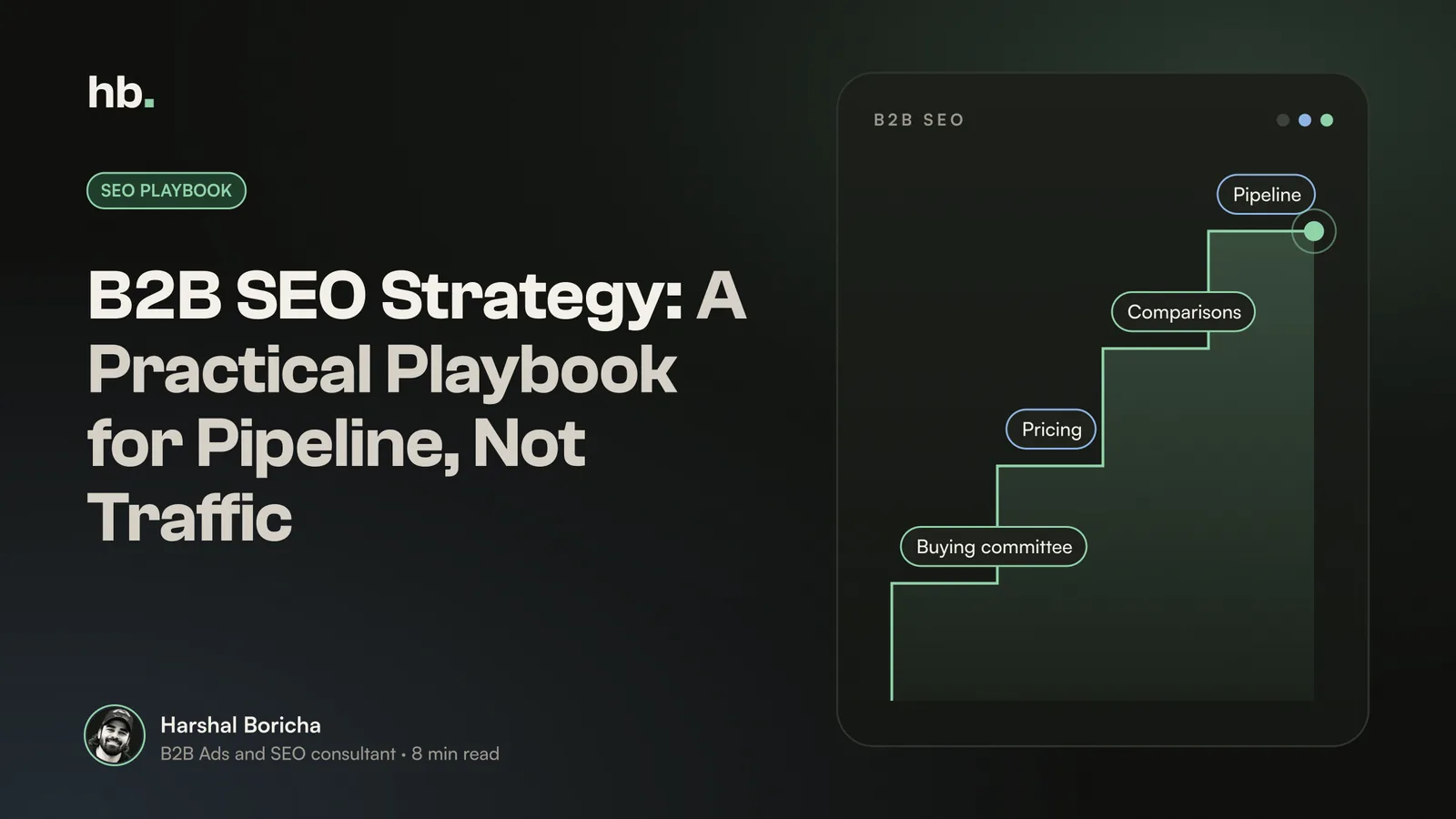
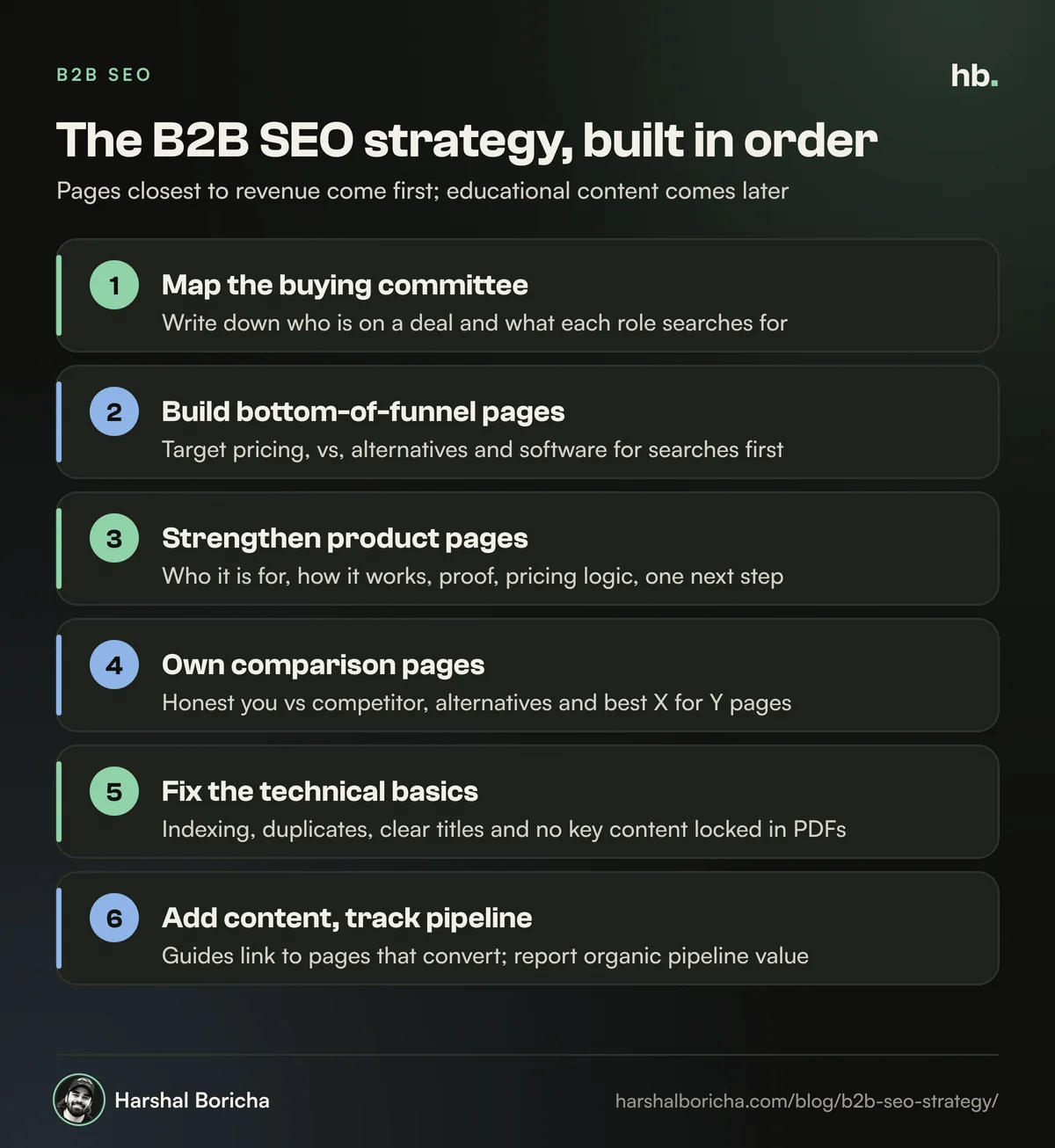
When I take on B2B SEO work, I follow almost exactly the order above. First, interviews with sales and a look at the CRM to understand the buying committee. Then an audit of product, solution and comparison pages, fixing the ones closest to revenue before anything else. Technical fixes run alongside. Educational content comes once the conversion pages are strong.
That approach works across very different businesses, from technical SaaS to industrial real estate, because it starts from how buyers actually search rather than from what a keyword tool suggests. If you want it applied to your site, see my B2B SEO service.
If you want a second opinion on your current B2B SEO strategy, or want help building one from scratch, you can book a call with me. I am happy to tell you honestly whether SEO is the right channel for you right now. You can also see all my services, including AI search optimisation.
The short version
- Write for the whole buying committee, not a single persona.
- Build bottom-of-funnel, product, solution and comparison pages before blog content.
- Value low-volume, high-intent keywords: a handful of the right searches beats thousands of the wrong ones.
- Fix the technical basics so Google can find and trust your key pages.
- Report on organic pipeline and revenue, and connect your forms to your CRM so you can.
Frequently asked questions
What is a B2B SEO strategy?
A B2B SEO strategy is a plan for earning organic search visibility with the people who buy for a business. It focuses on the buying committee, high-intent searches such as pricing, comparisons and solution queries, and pages that lead to sales conversations. Success is measured in qualified leads and pipeline rather than raw traffic or rankings.
How is B2B SEO different from B2C SEO?
B2B searches have far lower volume, longer sales cycles and several decision makers per purchase. Gartner puts a typical buying group for complex solutions at six to 10 people. So B2B SEO targets fewer, more specific keywords, writes for different roles in one company, and judges results on pipeline and revenue months later, not on next-day sales.
How long does B2B SEO take to show results?
Bottom-of-funnel pages on a site Google already trusts can start ranking and producing enquiries within a few months. Building authority for competitive category terms usually takes longer, often six to 12 months or more. The honest answer depends on your site's starting point, your competition and how quickly you can publish and improve pages.
Should a B2B company start with blog posts or product pages?
Start with product, solution, comparison and pricing pages, because they match searches from people already close to buying. Blog content that answers early research questions matters too, but it works best once the pages it links to are strong enough to convert the visitor it brings in.
How do you measure B2B SEO success?
Track organic leads, the share that become qualified, the opportunities and pipeline value they create, and closed revenue. Connect your website forms to your CRM so each lead keeps its original source. Rankings, impressions and traffic are useful early signals, but they are not the goal on their own.
Sources
- How to create a B2B SEO strategy in 9 steps (HubSpot)
- The B2B Buying Journey (Gartner)
- Opportunity-Based Marketing for B2B Marketers (Salesforce)
- What Is Keyword Intent? An Overview and How to Identify It (Semrush)
- A Complete B2B SEO Strategy Guide (Ahrefs)
- SEO Starter Guide: The Basics (Google Search Central)
- Creating Helpful, Reliable, People-First Content (Google Search Central)

B2B Ads and SEO consultant in Mumbai. Nine years in performance marketing, working only with B2B teams. More about me.
Want help with B2B SEO?
B2B SEO consultant in Mumbai. Technical SEO, keyword strategy and content that ranks for buying-intent searches and turns organic traffic into pipeline.