LinkedIn Thought Leader Ads are the closest thing LinkedIn has to paying for word of mouth. Instead of promoting a polished post from your company page, you put budget behind a post your founder, a sales head or even a happy customer wrote in their own voice. In most Indian B2B accounts I look at, this format is either missing completely or used once for a launch and then forgotten.
This guide covers what Thought Leader Ads are, how to set them up without getting stuck on approvals, when they beat company page ads and when they do not, what to budget in rupees, and how to measure them so they do not become a vanity metric.
What are LinkedIn Thought Leader Ads?
LinkedIn Thought Leader Ads let a company sponsor a post written by an individual member. The ad shows up in the feed under that person's name and photo, labelled as promoted, and it looks almost exactly like the organic post. LinkedIn's own description is that "the ad creative is your thought leader's post".
Three things make them different from normal Sponsored Content:
- The author owns the post. You cannot add a headline or intro text in Campaign Manager. LinkedIn's specs say edits must come from the original author.
- There is no call to action button. Any link has to be inside the original post, where it stays clickable once sponsored.
- The author has to approve. You request permission in Campaign Manager, and the author approves or declines.
When the format launched it was limited to employees. LinkedIn later opened it up so brands can request to sponsor posts from other members too, such as customers, partners and creators, as Search Engine Land reported at the time. That second change is bigger than it sounds for B2B, because a customer explaining why they chose you is far more believable than your own page saying it.
Why a named person beats a logo in B2B
B2B buyers trust people more than brands, and there is decent research behind that. The 2024 Edelman and LinkedIn B2B Thought Leadership Impact Report surveyed 3,500 business decision makers globally. Its headline findings include:
- 73% said thought leadership is a more trustworthy basis for judging a company's capabilities than its marketing materials.
- 75% said a piece of thought leadership had led them to research a product or service they were not previously considering.
- 86% said they were moderately or very likely to invite an organisation that consistently produces thought leadership to an RFP.
The same report found only 15% of buyers rate the thought leadership they see as very good or excellent. So the bar is low, but the reward for clearing it is high. A founder who writes clearly about a problem your buyers have will stand out simply because most content does not.
This is why I treat Thought Leader Ads as the top layer of a LinkedIn programme, not a side experiment. They build familiarity with the people who will later see your lead gen ads. I explain the full structure in my guide to LinkedIn Ads for B2B lead generation.
What you can and cannot promote
Before you plan a campaign around a post, check it is eligible. Based on LinkedIn's specs page:
| Post type | Can it be a Thought Leader Ad? |
|---|---|
| Single image post | Yes |
| Video post | Yes |
| Post with multiple images | No |
| Poll | No |
| Document (PDF carousel) post | No |
LinkedIn's best practices page lists the supported objectives as Brand Awareness, Engagement and Video Views. That is the most important limitation to understand. Thought Leader Ads are not a lead generation format on their own. You cannot attach a Lead Gen Form or a button, so if your plan is "boost the CEO's post and get demo requests", you will be disappointed.
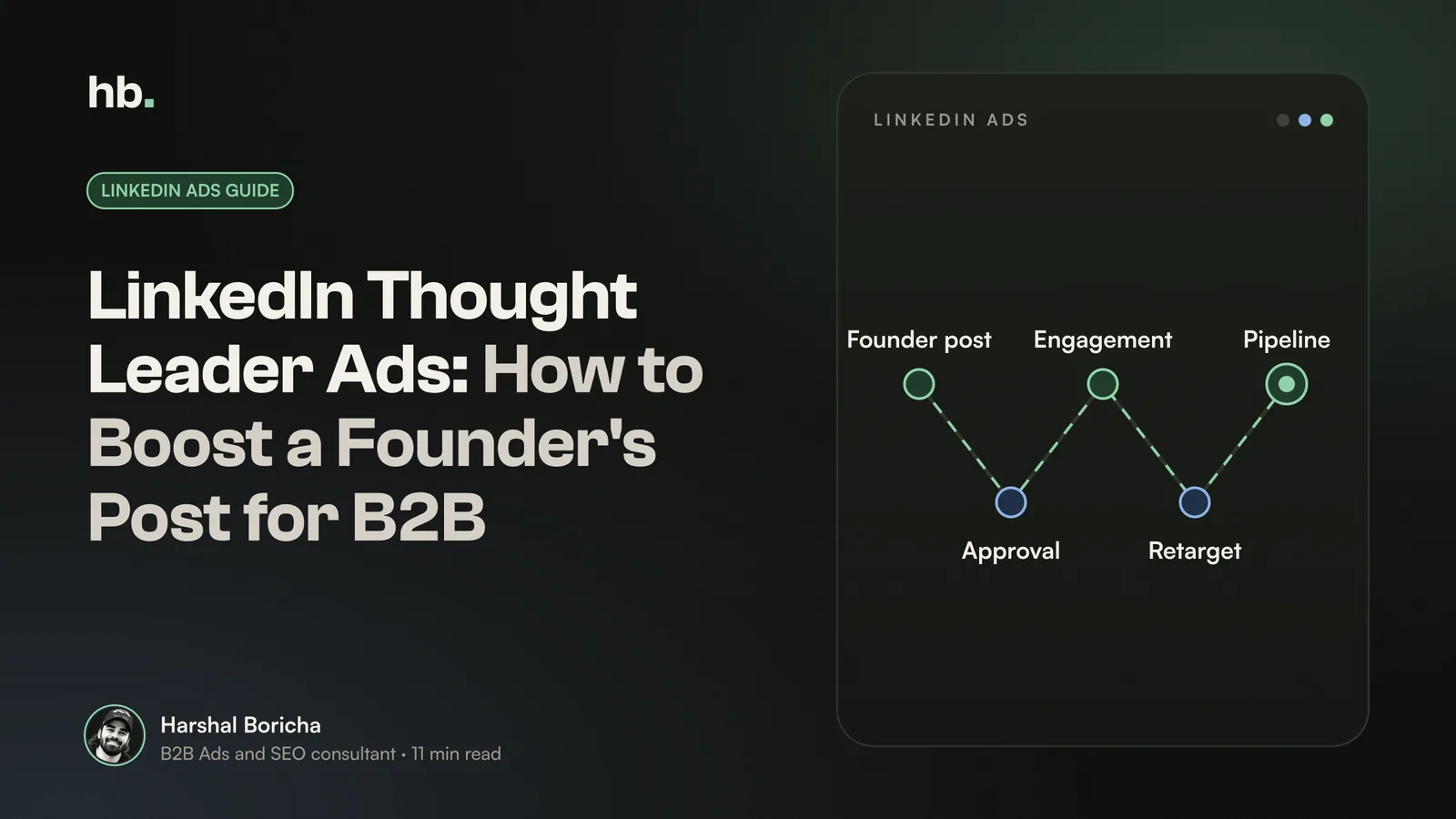
What they do well is reach and warm the right audience at a low cost per engagement. The leads come later, through retargeting.
How to set up Thought Leader Ads, step by step
Here is the process I follow. The screens change from time to time, so treat LinkedIn's Help Center as the final word if something looks different.
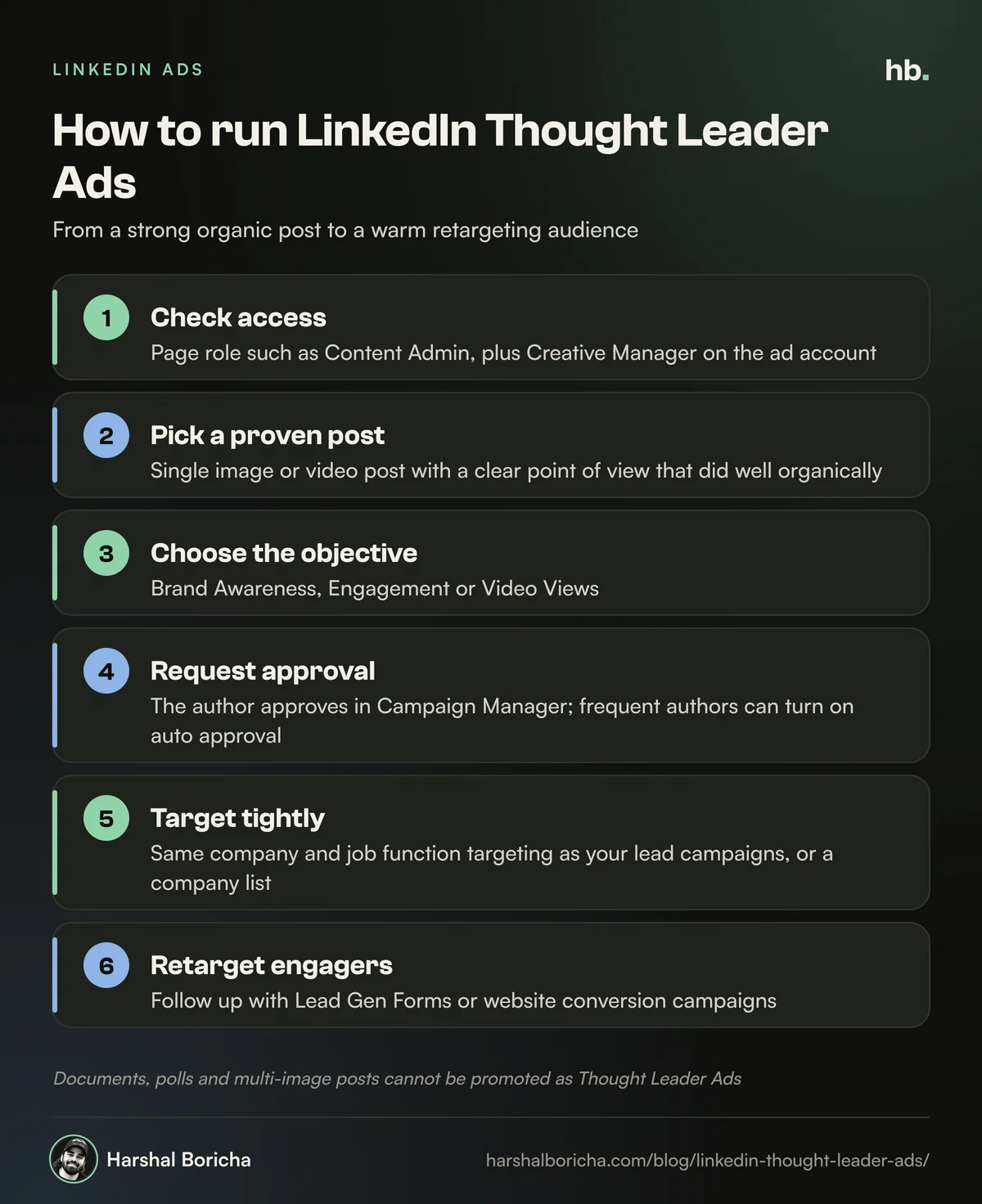
- Check your access. According to LinkedIn's setup guidance, as summarised by Factors.ai, you need a Page role such as Super Admin, Content Admin or Sponsored Content Poster, plus Creative Manager access or higher on the ad account.
- Pick the post first, then the campaign. Choose a post that already did reasonably well organically, with a clear point of view and no engagement bait. A post that flopped organically rarely becomes a great ad.
- Create a campaign with the right objective. Brand Awareness if you want reach among target accounts, Engagement if you want reactions, comments and follows, Video Views if the post is a video.
- Request permission. In the ad creation step, search for the person or paste the post URL, then request approval. LinkedIn notifies the author, and you can also send them the approval link directly. Requests show as pending, approved or declined.
- Ask frequent authors to switch on auto approval. Factors.ai notes that authors can enable automatic approval for a specific advertiser and switch it off later. For a founder who posts weekly, this saves a lot of chasing.
- Target tightly. Use the same company and job function targeting you would use for paid campaigns, plus a company list if you sell to a defined set of accounts. My guide to LinkedIn Ads targeting covers how to layer this.
- Build retargeting audiences from day one. Create engagement audiences from people who interacted with the ads so you can follow up with Lead Gen Forms or a website conversion campaign.
LinkedIn also has a useful tip for measurement: ask the author to note their organic numbers before the campaign starts, because the post will later show organic and paid results together.
When Thought Leader Ads beat company page ads
I reach for this format first in these situations.
Your buyers are senior and sceptical. CFOs, plant heads and IT heads scroll past brand ads. They are more likely to stop for a peer making a sharp point about a problem they have.
Your founder or a senior leader already posts well. If the content exists, sponsoring it is the cheapest way to put it in front of the people who matter. The post does the hard work.
You have customers willing to speak for you. A customer's own post, sponsored with their approval, does the job a case study does but in a format people actually read. Ask first, keep it in their voice, and do not script it into an advert.
You are running account based marketing. If you have a list of 200 to 500 target companies, Thought Leader Ads are a good way to make sure the buying committee keeps seeing a familiar face between sales touches.
Your company page has a small following. A new page has little social proof. A founder with a few thousand engaged connections often has more credibility in the feed than the brand does.
When company page ads still win
Thought Leader Ads are not the answer for everything. I still use company page Sponsored Content when:
- The goal is leads now. Lead Gen Forms, conversion tracking and a clear call to action need company page ads.
- The content is a document or carousel. Those formats are not eligible, so a gated or ungated Document Ad from the page is the right tool.
- You need to test many variations quickly. You cannot edit an author's post, so testing ten headlines is a company page job.
- The person might leave. If an author withdraws permission, live ads using that post stop. Build your programme on more than one voice.
The best setups run both: Thought Leader Ads at the top to build attention, company page ads lower down to convert it. If you are still deciding whether LinkedIn should be a main channel at all, my comparison of Google Ads vs LinkedIn Ads for B2B may help.
What LinkedIn Thought Leader Ads cost in India
Thought Leader Ads go through the same auction as other LinkedIn ads, so there is no rate card. LinkedIn's budget guidance sets a minimum of $10 a day per campaign for any format, a little under ₹1,000 at recent exchange rates. Your actual cost depends on the audience you target and how relevant LinkedIn judges the post to be.
Published benchmarks are thin and almost all US based, so read them as direction, not a forecast. The most detailed set I have found is from ZenABM, which looked at 2,828 LinkedIn ads across 211 companies. Its medians for Thought Leader Ads were a 2.68% click-through rate against 0.42% for single image ads, and a median cost per click of $2.29 against $13.23 for single image ads. ZenABM is careful to say this is not a like-for-like comparison, because clicks on a Thought Leader Ad include engagement such as expanding the post or visiting the profile, while single image clicks are mostly visits to a landing page. Still, the direction matches what I see: engagement on a person's post is much cheaper than engagement on a brand ad.
For a first test in India, this is roughly how I would budget. It is my working assumption, not a benchmark:
| Stage | Budget | What you are doing |
|---|---|---|
| Month 1 | ₹40,000 to ₹60,000 | Three to five of the founder's best posts, one target audience, Engagement objective |
| Month 2 | ₹50,000 to ₹75,000 | Keep the two best posts running, add new posts weekly, start retargeting engagers with Lead Gen Forms |
If you are new to LinkedIn pricing in general, my guide to LinkedIn Ads cost in India explains bidding and billing in more detail.
How to measure Thought Leader Ads properly
This is where most programmes fall apart. Likes are easy to report and easy to misread. Here is what I track instead.
Engagement from the right companies. Use Campaign Manager's company and job demographic reports to check who actually engaged. A thousand reactions from students and job seekers is worse than fifty from your target accounts.
Growth of the retargeting pool. The real output of a Thought Leader Ad is a warm audience. Track how many people from your target audience engaged, and how that pool grows month on month.
Cost per lead on the retargeting campaign. Compare Lead Gen Form results for people who engaged with Thought Leader Ads against cold audiences. If the warm audience converts better or more cheaply, the top layer is paying for itself.
Pipeline from target accounts. Over a quarter, look at whether accounts that engaged with the founder's posts are showing up in sales conversations. This needs your CRM to record the source properly, which I cover in my guide on B2B lead tracking with GA4 and your CRM.
Follower growth for the author. LinkedIn's page notes the format is meant to grow followers and engagement for the thought leader. It is a secondary metric, but a founder with a growing audience makes every future post cheaper to distribute.
Mistakes I see most often
- Boosting the wrong post. Announcements, award photos and "we are hiring" posts rarely work as ads. Opinions, lessons and clear explanations of a buyer problem do.
- Treating it as a lead campaign. Without a button or a form, judging Thought Leader Ads on leads alone makes them look like a failure.
- Targeting too broadly. Cheap engagement from the wrong audience is still waste. Keep the same discipline you use for paid lead gen.
- Ignoring the comments. A sponsored post gets comments from strangers. If the author does not reply, the ad looks abandoned. Agree on who responds before launch.
- Relying on one voice. If one person writes all the content and later leaves or withdraws approval, the programme stops overnight. Build two or three voices over time.
- Ghostwriting it into a brochure. If the post reads like marketing copy, you lose the reason the format works. Edit for clarity, not for brand language.
How I run Thought Leader Ads for clients
My usual approach is simple. I sit with the founder or a senior leader once a month and pull out three or four strong points they already make in sales calls. They post those in their own words. I then pick the posts that resonate organically, sponsor them to a tight list of target companies and roles, and feed everyone who engages into retargeting campaigns with a relevant offer.
The paid side sits inside my LinkedIn Ads management work, and the same ideas often become articles that support B2B SEO and get picked up by AI assistants, which is part of my AI search optimisation service. If search demand exists for your category, I would also run B2B Google Ads alongside, so people who hear about you on LinkedIn can find you when they search.
If you want a quick view on whether your founder's content is ready to sponsor, book a call and I will tell you honestly.
The short version
- LinkedIn Thought Leader Ads let you sponsor a post written by a person, with their approval, including customers and partners as well as employees.
- Single image and video posts are eligible. Documents, polls and multi-image posts are not.
- The supported objectives are Brand Awareness, Engagement and Video Views, so use them to warm audiences, then convert with retargeting.
- Costs run through the normal auction from $10 a day. Plan roughly ₹40,000 to ₹75,000 a month for a first test.
- Measure engaged target accounts, retargeting pool growth and pipeline, not likes.
Frequently asked questions
What are LinkedIn Thought Leader Ads?
Thought Leader Ads let a company pay to promote a post written by a person, such as a founder, an employee, a customer or an industry expert, instead of a post from the company page. The post appears in the feed under the person's name and photo, marked as promoted, and the author must approve the request before it can run.
Can I sponsor a post from someone who does not work at my company?
Yes. LinkedIn first limited Thought Leader Ads to employees, then opened them up so brands can request to sponsor posts from other members, such as customers, partners and creators. You find the person or paste the post URL in Campaign Manager, and the author approves or declines the request. They can also withdraw permission later, which stops the ad.
Which campaign objectives support Thought Leader Ads?
LinkedIn lists Brand Awareness, Engagement and Video Views as the objectives for Thought Leader Ads. That means they are not built for lead generation on their own. I use them to warm up the right audience, then retarget the people who engaged with Lead Gen Forms or website conversion campaigns.
How much do Thought Leader Ads cost in India?
They run through the same auction as other LinkedIn ads, so there is no fixed price. The LinkedIn minimum is $10 a day per campaign, a little under ₹1,000. For a useful test on one founder's posts I would plan roughly ₹40,000 to ₹75,000 a month for two months, then judge the results on engaged target accounts and the retargeting pipeline they create.
Can I promote a LinkedIn document or poll post as a Thought Leader Ad?
No. LinkedIn's specs say posts with multiple images, polls or documents cannot be promoted as Thought Leader Ads. Single image and video posts are the main eligible formats. If your best content is a carousel style PDF, use a company page Document Ad for that piece instead.
Sources
- Thought Leader Ads specs (LinkedIn Marketing Solutions)
- Thought Leader Ads best practices (LinkedIn Marketing Solutions)
- Making the Most of Your Budget (LinkedIn Marketing Solutions)
- LinkedIn now allows brands to sponsor any organic post (Search Engine Land)
- Reaching Beyond the Ready: 2024 B2B Thought Leadership Impact Report (Edelman)
- LinkedIn Thought Leader Ads benchmarks (ZenABM)
- LinkedIn Thought Leader Ads: How to Run Them in 2026 (Factors.ai)

B2B Ads and SEO consultant in Mumbai. 15+ years of experience, nine in performance marketing, working only with B2B teams. More about me.
Want help with LinkedIn Ads?
LinkedIn Ads consultant for B2B teams. Account-based targeting, lead gen forms and Meta retargeting that turn the right companies into qualified pipeline.