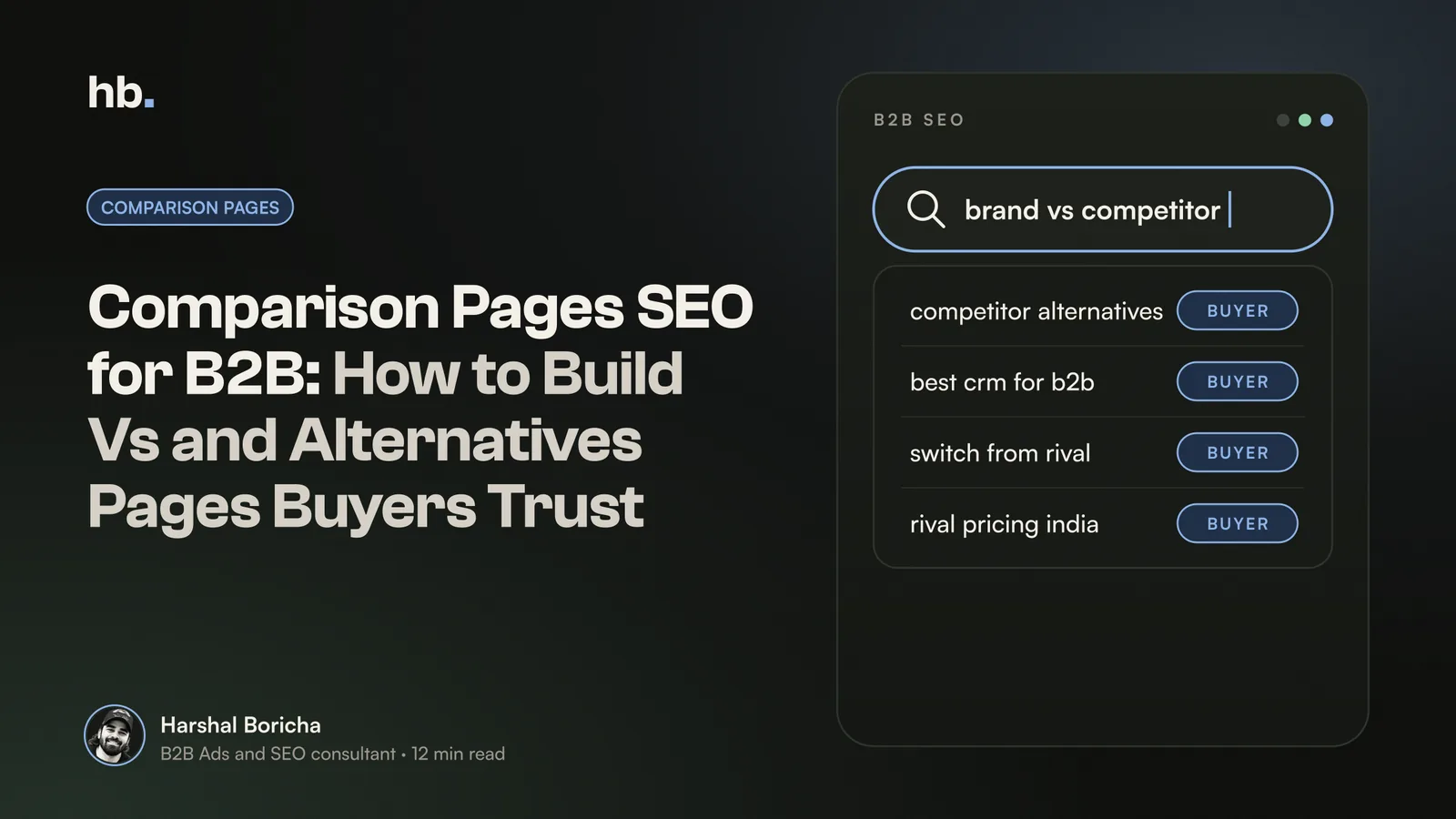
Comparison pages SEO is the cheapest pipeline most B2B companies ignore. Somebody types "your brand vs competitor" or "competitor alternatives" into Google or ChatGPT, and they are already shortlisting. If the only pages they find were written by your competitor or by an affiliate site, you have lost the framing of the deal before sales even hears about it. My short answer: build a few fair vs and alternatives pages for the competitors you meet most in deals, say clearly where each rival is the better fit, back every claim with a source, and keep the pages current.
The rest of this post covers which pages to build first, a section-by-section template, the legal line in India, what Google changed this year and what AI assistants do with these pages.
Why B2B buyers read comparison pages
A B2B purchase is mostly decided before anyone fills in your form. 6sense's 2025 Buyer Experience Report, based on more than 4,000 buyers, found that the vendor buyers prefer before they engage with sellers still wins 80% of deals. Whoever shapes the comparison early has a large head start.
AI has made the comparison stage even more important. G2's 2026 Buyer Behavior Report, published in July 2026 and based on a survey of more than 1,000 B2B software buyers, found that 82% had sourced software recommendations from an AI chatbot in the last 24 months. Half of those buyers said AI mattered most when narrowing and comparing options. G2 also found that evaluation is now the longest stage of buying, longer than research for the first time.
Put those together. Buyers spend more time comparing, more of that comparing happens in places you do not control, and the favourite going into the first sales call usually wins. A good comparison page is one of the few assets that can influence all three.
These searches are small, and keyword tools often show close to zero volume for them. That is fine. In my B2B SEO strategy guide I argue for building bottom-of-funnel pages before blog posts, and comparison pages sit right at the bottom.
What changed recently
Four updates from this year matter for anyone publishing vs or alternatives pages.
- September 2026 spam update (24 September to 8 October 2026). Google rolled out a spam update that applied globally and to all languages. Search Engine Roundtable reported it took about two weeks, longer than the last few spam updates. It did not target link spam. If your comparison pages are thin templates, this is the kind of update that finds them.
- Spam policies page updated on 28 August 2026. Google's definition of scaled content abuse still covers "many pages" made mainly to manipulate rankings, "no matter how it's created". Generating hundreds of "X vs Y" pages from one template with an AI tool fits the examples Google lists.
- Review snippet rules tightened (July 2026, page last updated 8 September 2026). Google added a guideline against fake and undisclosed incentivised reviews, including reviews written in exchange for money, discounts, vouchers or free products. The older rule on self-serving reviews still applies too.
- Ahrefs tested self-promotional "best of" lists in AI search (published 6 July 2026). Across 9,886 AI answers collected between February and May 2026, pages that ranked their own brand first often got cited while a competitor on the same list got the recommendation. More on this below, because it changes how I write alternatives pages.
The three comparison pages worth building
| Page type | Example search | Who is searching | What the page must do |
|---|---|---|---|
| You vs competitor | "your brand vs competitor" | A buyer with both of you on the shortlist | Compare fairly, show where each fits, make the switch feel safe |
| Competitor alternatives | "competitor alternatives" | Someone unhappy with an incumbent tool or agency | Name the common reasons people leave, show several options, including yours |
| Best X for Y | "best CRM for Indian manufacturers" | Early shortlisting, often via AI assistants | Give a fair, sourced list with clear criteria, without forcing yourself to number one |
Most B2B companies only need the first two to start. Category roundups take more upkeep and carry the self-promotion risk that the Ahrefs test found.
Comparison pages SEO: which competitors to cover first
Do not start in a keyword tool. Start with your own deal data, because the competitors that matter are the ones you meet in sales calls, not the ones with the biggest search volume.
- Ask sales which names come up most. Sit with two or three sales people for 30 minutes and ask who you lose to, who you beat and what prospects say about each.
- Pull lost-deal reasons from the CRM. If your team records a competitor field on closed-lost opportunities, sort by count. That list is your priority order.
- Check Search Console. Filter the Performance report with a regular expression such as
vs|versus|alternative|compareto see comparison queries you already get impressions for. - Read your Google Ads search terms. Competitor and comparison terms often show up there first. My guide to Google Ads for B2B covers how to read that report.
- Ask AI assistants. Type "best alternatives to [competitor] for [your buyer]" into ChatGPT, Gemini and Perplexity. Note which pages they cite. Those are the pages you are up against.
My B2B keyword research guide goes deeper on mining sales calls and the CRM for terms like these.
April Dunford puts the starting point well:
"Understanding what your best customers see as true alternatives to your solution will lead you to your differentiators." April Dunford, Obviously Awesome (2019)
Her point matters here. Your true alternative is sometimes a spreadsheet, an in-house team or doing nothing, and that deserves a page too. Her video A Buyer-Centric Approach to Competitive Positioning, on her own YouTube channel, separates status quo alternatives, direct rivals and "do nothing" outcomes, and each needs a different argument.
A comparison page template that ranks and converts
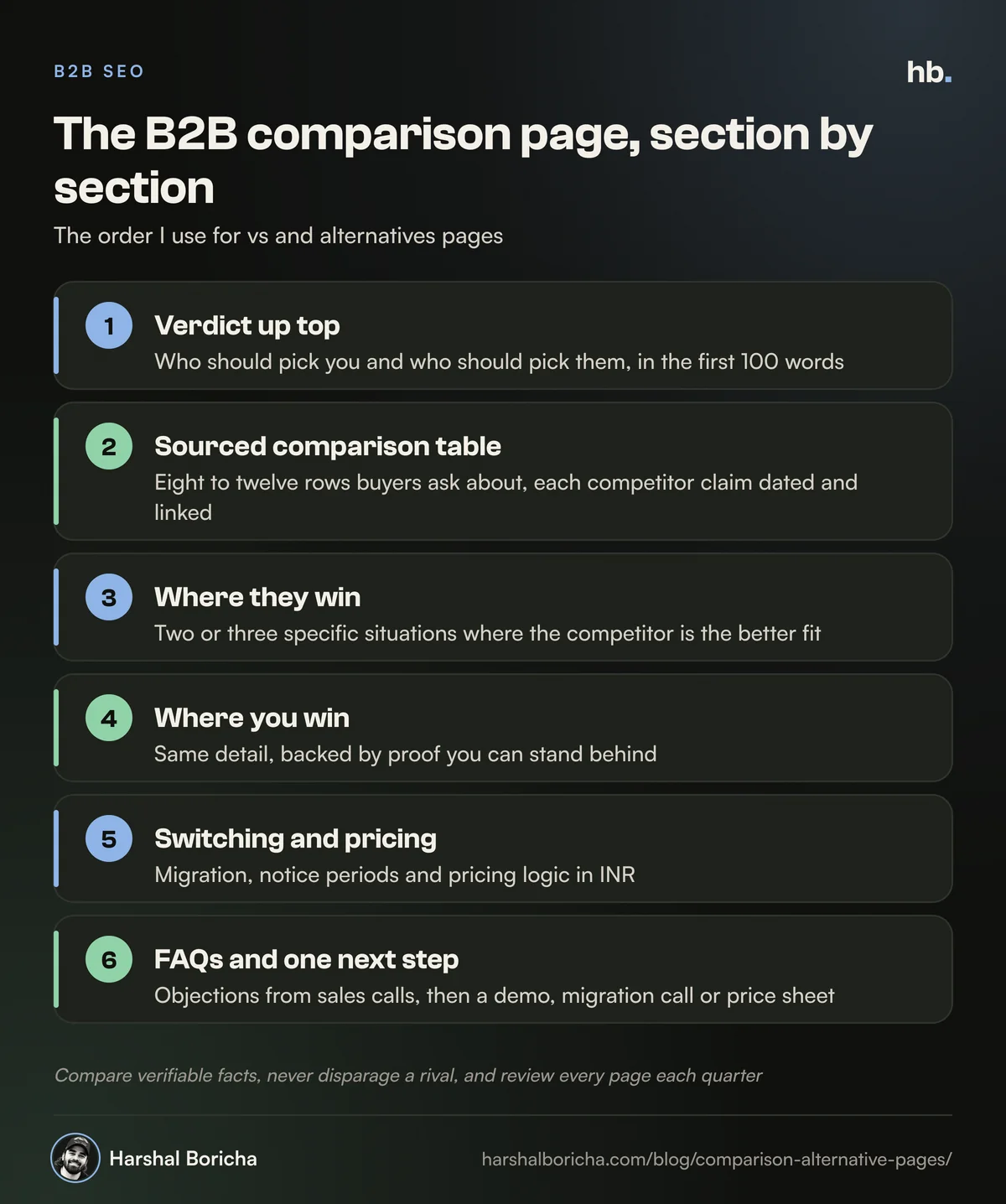
This is the structure I use for a vs page. An alternatives page follows the same order, with a short section for each option.
- A title and H1 that match the search. "Your brand vs competitor: which is right for a 200-person manufacturer?" works better than a clever headline. Put the year in only if you will update it every year.
- A verdict in the first 100 words. Tell the reader who should pick you and who should pick them. Busy buyers and AI assistants both read the top of the page first.
- A comparison table. Eight to twelve rows on the things buyers ask about: pricing model, implementation time, integrations, support hours in India, data residency, contract terms. Add a "last checked" date and a source link for every competitor claim.
- Where the competitor is the better choice. Write two or three specific situations. This section earns more trust than anything else on the page.
- Where you are the better choice. Same format, same level of detail. Use proof you can stand behind, such as certifications, published pricing or links to independent review profiles.
- What switching involves. Data migration, contract notice periods, training. Fear of switching kills more deals than features do.
- Pricing in INR, or at least the pricing logic, if you sell in India. A line like "plans start at ₹25,000 a month" filters people better than "contact us".
- FAQs from sales calls, written in the words prospects use.
- One clear next step, such as a demo, a migration call or a price sheet.
Google's guidance on writing reviews reads like a checklist for this page. It asks writers to "explain what sets something apart from its competitors" and to "cover comparable things to consider, or explain which might be best for certain uses or circumstances." It also asks for evidence of first-hand expertise and for benefits and drawbacks "based on your own original research." If you have used the competitor's product, show it with screenshots and dates.
Sam Dunning's video SaaS SEO Hack: Steal Competitors Leads (Alternatives Pages), on his Breaking B2B channel, makes the case for alternatives and vs pages for software companies. Watch it if your leadership needs convincing that these pages are worth the effort.
Be fair, and say when the competitor wins
Most founders resist this. They worry that admitting a competitor is better at anything will lose deals. In my experience the opposite holds. Buyers already know your rival's strengths from review sites and AI answers. When your page leaves them out, the reader stops trusting everything else on it.
The Ahrefs experiment put numbers on a related risk. When AI assistants cited the self-promotional conference pages, 43% of those answers never mentioned the brand being promoted. The author's summary: "Being cited and being recommended turned out to be two very different things." The AI used the page as research, then recommended someone else. For an established brand, only 6% of new AI mentions came from its own pages; 94% came from third-party content.
My takeaways from that test:
- Include yourself where you belong, but do not manufacture a ranking that puts you first on every list.
- Make the criteria explicit, so a reader or an AI can see why each option suits a particular buyer.
- Fact-check every competitor claim and date it.
- Earn mentions on independent sites too. Your own page will rarely carry the recommendation alone.
There is a sales benefit as well. When a page tells the wrong-fit buyer to go elsewhere, your sales team stops spending weeks on deals that would churn anyway.
The legal line in India
Naming a competitor is allowed in India, within limits. I am not a lawyer, so treat this as a starting point and get legal review for anything sharp.
The ASCI Code permits comparisons, including ones that name a competitor, as long as several conditions hold. Clause 4.1 says the aspects being compared must be clear, the subject must not be chosen to give an artificial advantage, claims must be factual and capable of substantiation, consumers must not be misled, and the advertisement must not "unfairly denigrate, attack or discredit other products, advertisers or advertisements." Clause 4.2 adds that ads "shall not make unjustifiable use of the name or initials of any other firm," or take unfair advantage of another brand's goodwill.
Indian courts have drawn a similar line. As S.S. Rana & Co. summarises the case law, you may puff up your own product and even claim to be the best. You may not say a rival's product is bad. Cases such as Reckitt & Colman v. M.P. Ramachandran and Pepsi Co. v. Hindustan Coca Cola set out that test.
For a comparison page, that translates into a few practical rules:
- Compare specific, verifiable features, with a source and date for each claim about the rival.
- Use the competitor's name to identify them, not their logo or design.
- Never call their product bad, unsafe or a scam. Describe the situations where it fits less well.
- Keep a file of evidence for every claim in case someone complains.
- Fix errors quickly when a competitor points one out.
Paid search has its own trademark rules. If you plan to bid on competitor names, that is a separate decision, and I cover it in my Google Ads management work.
Comparison pages and AI search
AI assistants love comparison content because it already answers the question the user typed. That cuts both ways. Your page can become the source an assistant reads, and the assistant can still recommend a rival if your page gives it reason to.
What helps, based on the Ahrefs findings and Google's own guidance:
- Plain, structured facts. Tables, dated pricing and clear "best for" statements are easy to extract and quote.
- Fit to the exact query. In the Ahrefs test, the promoted conference appeared in 66.4% of answers to the narrow query it was built for and only 15.8% for a broader one. Build pages for the specific comparison your buyers make.
- Independent proof. Since most AI mentions of an established brand came from third-party content, your review profiles, analyst mentions and partner pages matter as much as your own page.
My explainer on generative engine optimisation covers the wider picture, and my AI search optimisation service is where I track how assistants describe a brand against its competitors.
Mistakes I see most often
- Templating at scale. Fifty near-identical "X vs Y" pages with swapped names. After the September 2026 spam update, I would not risk it. Write fewer pages by hand.
- Outdated competitor pricing. A wrong price on a rival is the fastest way to lose a reader and invite a complaint. Set a review date on every page, and recheck when the competitor changes plans.
- Marking up testimonials as reviews. Google says self-serving reviews on Organization or LocalBusiness pages are not eligible for star review features. Link to G2, Capterra, Clutch or Google reviews instead.
- Hiding the page. Many companies build comparison pages and then leave them out of navigation and internal links. Link to them from product pages, pricing and relevant blog posts.
- Gating the comparison. Putting the table behind a form means Google and AI assistants cannot see it, and nor can a buyer in a hurry.
- Letting marketing write it alone. Sales knows the objections. Product knows the roadmap. Both should review the page before it goes live.
How to measure comparison pages
Traffic will look small. Judge these pages on what they put into the pipeline.
- Track form fills and demo bookings from each comparison page as a separate landing page group.
- Pass the landing page into the CRM with every lead, so you can see which comparison pages create qualified opportunities. My guide to B2B lead tracking with GA4 and your CRM shows the setup.
- Ask "how did you hear about us?" as an open text field. Buyers who read a comparison page or saw you in a ChatGPT answer often say so.
- Watch win rate against each named competitor before and after the page goes live. Sales usually notices first.
A hypothetical example to show the maths: if a vs page brings 60 visits a month and two of those become qualified opportunities each quarter, with an average annual contract of ₹10 lakh and a 25% win rate, that page is worth about ₹5 lakh of new revenue a quarter. Your numbers will differ, so run them with your own CRM data.
How I build comparison pages for clients
When I take on B2B SEO work, comparison pages are usually in the first month, right after the product and pricing pages. I start with sales interviews and the CRM to pick the competitors, draft the pages with sales and product in the room, and set a quarterly review for each one.
They also connect to paid media. A strong vs page makes a better landing page for competitor search campaigns than the home page, and the same proof points work in LinkedIn Ads aimed at accounts using a rival tool.
If you want me to look at which comparisons your buyers make and which pages you are missing, book a call.
The short version
- Comparison pages SEO is about influencing a shortlist that is mostly decided before the first sales call.
- Pick competitors from your CRM and sales calls, not from search volume.
- Lead with a verdict, compare in a sourced table, and say where the competitor is the better choice.
- In India, compare verifiable facts and never disparage a rival; get legal review for strong claims.
- Write a few pages by hand, keep them current, and measure them on pipeline.
Frequently asked questions
What are comparison pages in SEO?
Comparison pages are pages built for searches where a buyer weighs options, such as "your brand vs competitor", "competitor alternatives" or "best software for a use case". They target people close to a decision, so search volume is low but intent is high. For B2B companies they often produce more qualified enquiries than blog posts with far more traffic.
Is it legal to name a competitor on a comparison page in India?
Comparative advertising is not banned in India. The ASCI Code allows comparisons when the points compared are clear, the claims are factual and can be substantiated, consumers are not misled and the rival is not unfairly denigrated. Indian courts have allowed puffing up your own product but not disparaging a competitor's. Get a lawyer to review any page that makes strong claims about a named rival.
Should I say where a competitor is better?
Yes. Buyers check claims against review sites, AI assistants and the competitor's own site, so a one-sided page loses trust quickly. Saying who the competitor suits better also filters out leads you would struggle to win or keep, and it gives AI assistants a fair summary to cite.
How many comparison pages should a B2B company build?
Start with the two or three competitors that come up most in your deals, plus one alternatives page for the market leader. Add more only when you can keep them accurate. A handful of well-maintained pages beats fifty templated ones that go stale and risk looking like scaled content.
Can I use review schema on my own comparison pages?
Be careful. Google's review snippet rules say that if the entity being reviewed controls the reviews about itself, its LocalBusiness or Organization pages are not eligible for star review features. Google also asks you not to include fake or undisclosed incentivised reviews. Link to independent review sites instead of marking up testimonials as reviews.
Sources
- Write high quality reviews (Google Search Central)
- Review snippet structured data guidelines (Google Search Central)
- Spam policies for Google web search (Google Search Central)
- Google September 2026 Spam Update Is Done Rolling Out (Search Engine Roundtable)
- New G2 Research: AI Is Reshaping How B2B Software Deals Are Won and Lost (G2, 2026 Buyer Behavior Report)
- The Timeline for Influencing B2B Buyers Is Shrinking: 6sense 2025 Buyer Experience Report (Business Wire)
- Self-Promotional Content Works, Until It Backfires: AI SEO Experiment (Ahrefs)
- The Code for Self-Regulation of Advertising Content in India (ASCI)
- Legality of Comparative Advertisements in India (S.S. Rana & Co.)
- Obviously Awesome by April Dunford, quotes (Goodreads)
- A Buyer-Centric Approach to Competitive Positioning (April Dunford, YouTube)
- SaaS SEO Hack: Steal Competitors Leads (Alternatives Pages) (Sam Dunning, Breaking B2B, YouTube)

B2B Ads and SEO consultant in Mumbai. 15 years of experience, nine of them in performance marketing, working only with B2B teams on Google Ads, LinkedIn Ads, SEO and AI search.
Want help with B2B SEO?
B2B SEO consultant in Mumbai. Technical SEO, keyword strategy and content that ranks for buying-intent searches and turns organic traffic into pipeline.